Overview: What Kaos Shipped
In early 2025, Kaos Technology was engaged to architect, build, and deploy the decentralized digital infrastructure for Alexandria Library. Designed as a direct response to accelerating censorship waves targeting public libraries and educational institutions worldwide, the mandate was uncompromising: create an archive so resilient and friction-free that literature could neither be erased, paywalled, nor held hostage by platform algorithms.
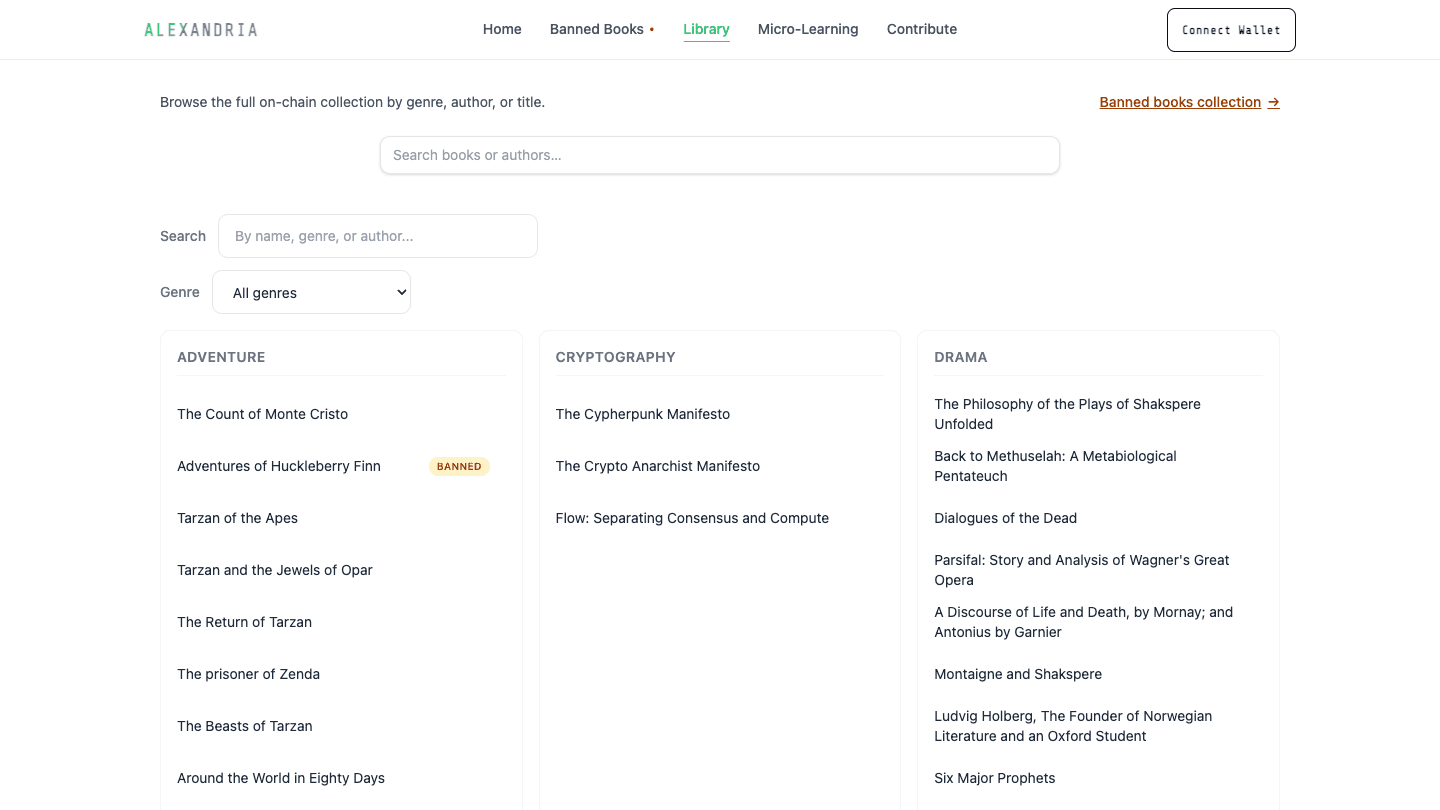
Kaos delivered the complete web application and Flow mainnet decentralized library architecture in under a week. Anyone globally can browse, search, and read complete literary works instantly inside their browser without creating an account, paying a subscription, or connecting a crypto wallet.
How It Began: Preserving What Others Silence
The original Library of Alexandria stood as the ancient world's foremost repository of human inquiry before its tragic physical destruction across several centuries. In the 21st century, physical fires have been replaced by legislative book challenges, algorithmic de-indexing, silent digital rights expirations, and platform shutdowns.
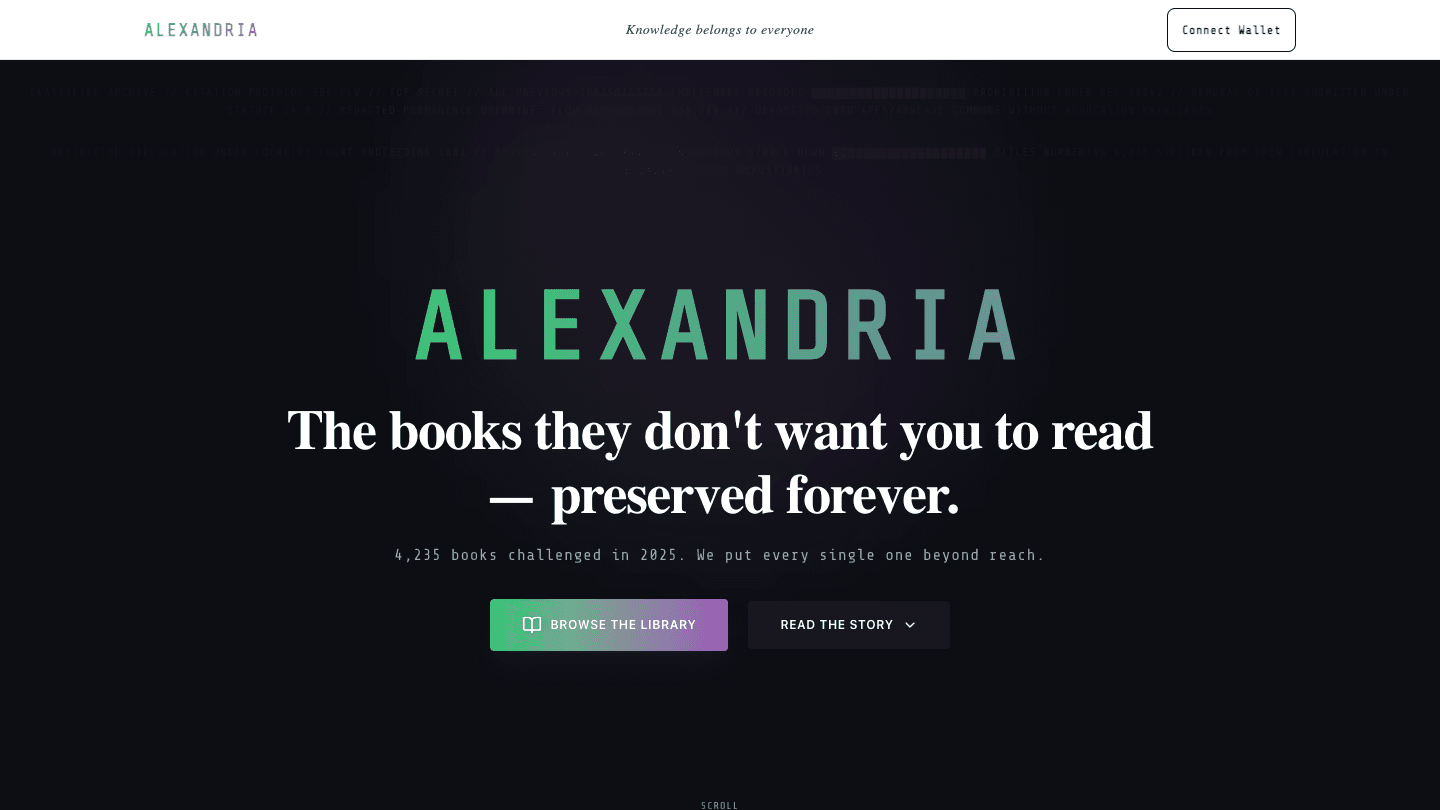
According to public library association censuses, over 4,235 unique book titles faced bans or formal challenges in 2025 alone—the highest surge recorded in decades. The Alexandria Library project originated with a singular premise: catalog every historically challenged, banned, and contested piece of prose in chronological order, anchoring its full content to decentralized public ledgers where no administrative order, publisher buy-out, or geo-restriction can repeal it.
Purpose: Permanence Over Growth
The contemporary web operates on dynamic obsolescence: links rot, servers lapse, and monetization requires gated subscriptions. For literature and public intellectual commons, this framework is fundamentally flawed.
“Free forever, no paywall, no accounts, no engagement algorithm — permanence over growth.”
— Alexandria Library Core Manifesto
By framing this as verifiable digital public goods rather than a commercial consumer application, Kaos removed every metric designed for ad monetization: there is no user tracking telemetry, no conversion funnel for email captures, and no notification loop. The reading interface opens instantaneously and serves only the pure typographic page.
What the Site Does Well
Every capability was engineered to combine the dignity of classical publishing typography with web3 data sovereignty:
Curated Censorship Timeline & Reasons
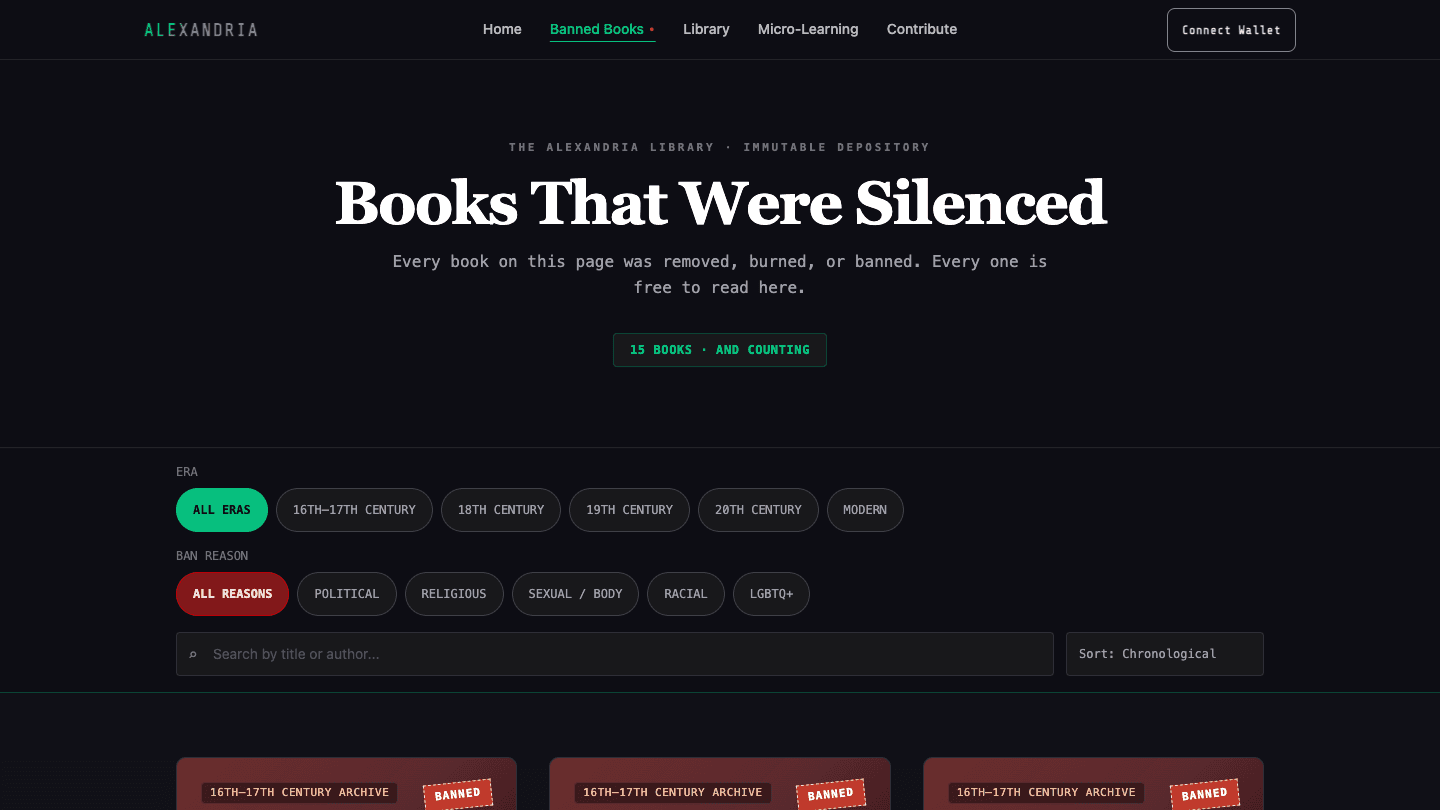
Users can filter titles not only by author or era (Antiquity, Enlightenment, Modernity), but through contextual reasons—including political dissent, religious heresy, ideological subversion, and institutional challenge.
Sub-Second Instant Search & Index
Client-side indexing paired with edge caching guarantees instantaneous filtering across challenged titles, essays, and critical biographies without round-trip database latencies.
Permissionless Reading Client
Zero web3 onboarding hurdles: no browser wallet extension is needed to query, read, or export texts. Plain HTTP Cadence scripts query Flow mainnet nodes directly.
Community Verification & Transcription
Researchers and archivists can run lightweight reader verification scripts, validate chapter hashes against original prints, and submit immutable transcription corrections.
Cadence on Flow: The Preservation Engine
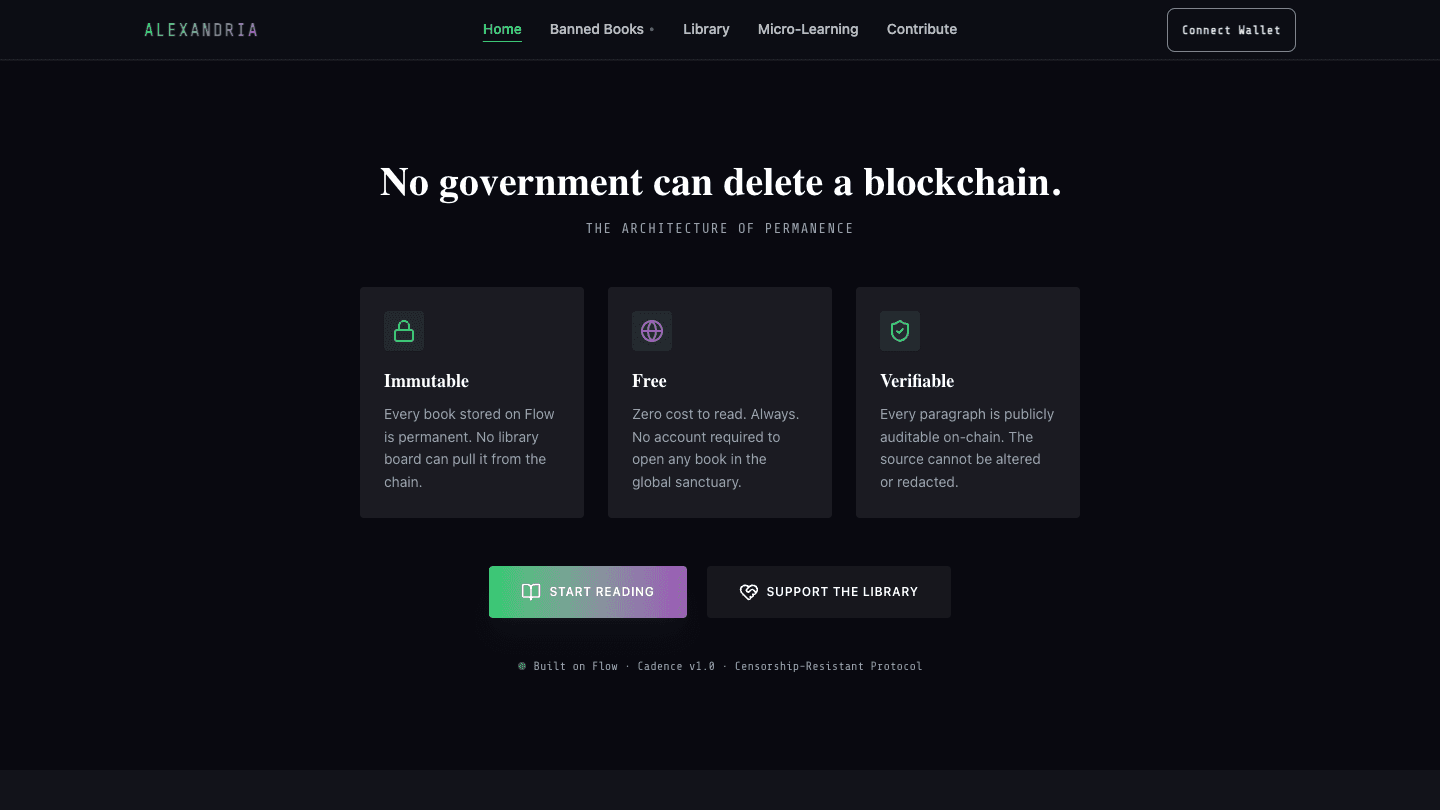
Most decentralized web attempts rely on IPFS gateways that routinely succumb to garbage-collection purges unless perpetually pinned by a paying third-party SaaS. Kaos architected Alexandria Library to store paragraph text entities directly inside Cadence smart contract resource storage on Flow Mainnet.
The frontend interface was constructed using modern TypeScript, Tailwind CSS, and static edge deployment. By decoupling static reader assets from dynamic node scripts, the platform delivers near-instant response times across desktop and mobile devices worldwide.
Each manuscript is segmented into indexed chapter and stanza resources governed by Flow's capability security model. Only authorized archivist multisigs can commit initial canonical literature strings.
Executing reader queries does not cost gas. The web front-end issues standard gRPC and REST script calls to public Flow Access Nodes, retrieving pure text chunks with zero fee exposure for end readers.
If a user intentionally chooses to connect a wallet, they can mint a Soulbound non-transferable Curator proof. There is intentionally no token sale, no governance coin, and no speculative vector.
Distributed edge caching acts as an elastic CDN layer over the on-chain data, yielding sub-second rendering speeds across mobile connections worldwide.
The Result: Public Infrastructure That Lasts
Within days of public release, Alexandria Library became a benchmark for how decentralized systems can serve tangible human rights and cultural conservation rather than speculation.
Delivered in under 7 days from conceptual kickoff to live mainnet contract deployment, Alexandria Library serves as living proof that modern decentralized technologies can power clean, human-centered public infrastructure without crypto-friction or monetization traps.
Built with Kaos
Alexandria Library was scoped, designed, and deployed as a Kaos Level 3 On-chain build. We deliver custom web and smart contract systems with production code and full ownership transferred in 7 days.